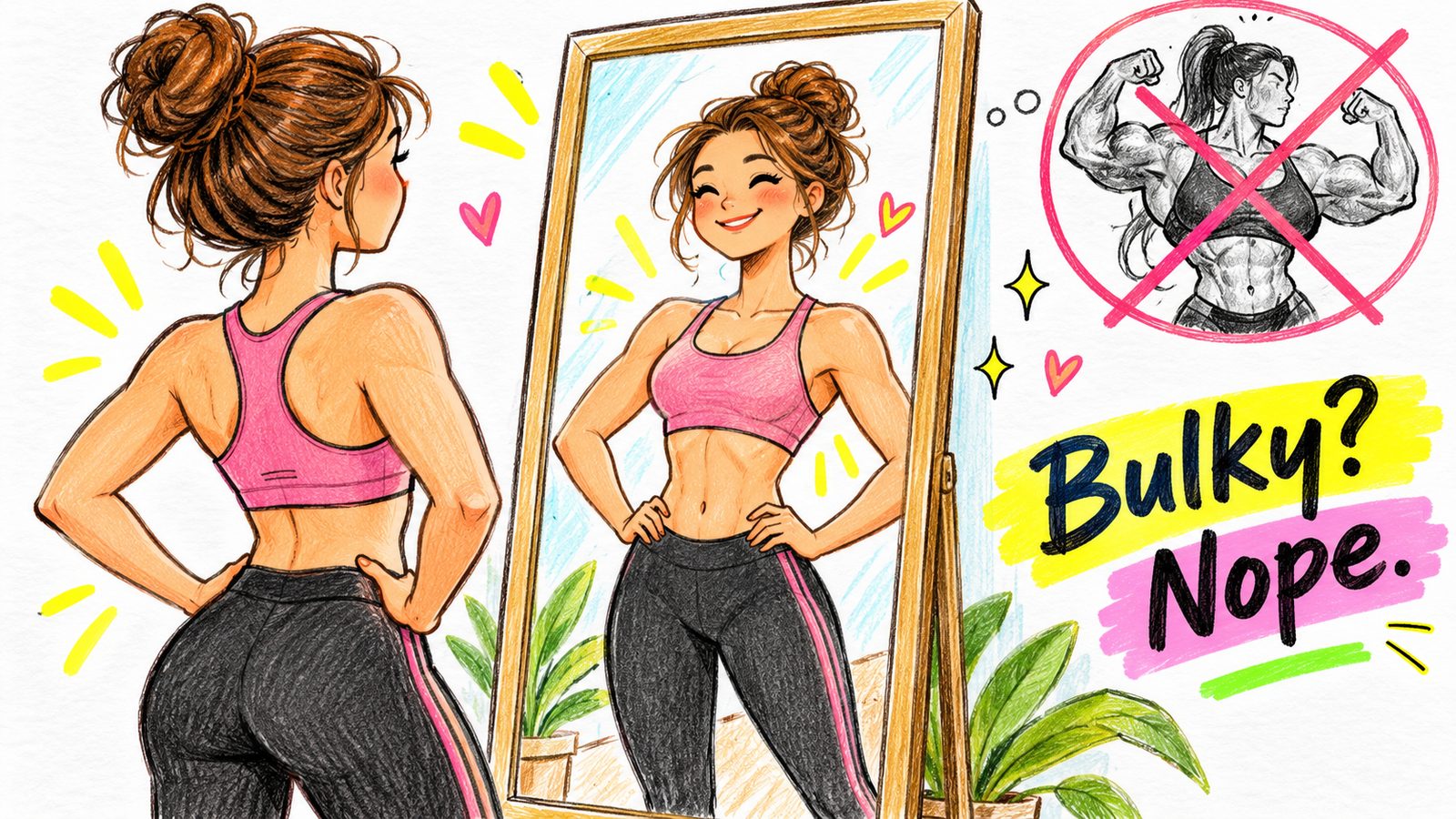
Quick answer: No. Creatine pulls a little water inside muscle cells and helps you train slightly harder. It does not add body fat, and it cannot override the physiology that keeps women from accidentally gaining large amounts of muscle: far lower testosterone than men, plus the need for a calorie surplus and years of heavy progressive training.
In studies, creatine users gain a few extra pounds of lean mass over months of training compared with placebo. That is firmer and stronger, not bulky.
Where the bulky fear comes from
Creatine grew up in locker rooms. For decades the most visible creatine users were young men chasing size, so the supplement inherited a bodybuilder reputation it never earned on its own. When women hear that a side effect is "weight gain," the mental image is instant: bigger, puffier, bulkier.
The scale does often move early. That is real, and it deserves a straight explanation rather than dismissal.
But early scale movement and muscle bulk are two completely different things, built by different mechanisms on different timelines. Confusing them is where the fear lives.
What creatine actually does inside muscle
Creatine is stored mostly in skeletal muscle, where it helps regenerate ATP, the fast fuel for short bursts of effort. A fuller creatine tank means you might squeeze out an extra rep or recover a bit faster between sets.
That is the whole performance story. It is small, useful, and entirely about training quality.
As muscle creatine rises, water follows it inside the muscle cell. A 2021 evidence review concluded that this short-term water increase is intracellular, meaning inside the cell, not the subcutaneous bloat that changes how your face or waistline looks. This is also why creatine does not increase fat mass: the review addressed that claim directly and found no support for it.
None of this is a muscle-growth signal by itself. Creatine does not flip a "grow large" switch. It makes your training slightly more productive, and the training does the rest.
Why women don't accidentally get bulky: the testosterone gap
Getting genuinely bulky is a project, not an accident. It requires three things at once: a sustained calorie surplus, years of progressive heavy training, and enough androgens to drive large-scale muscle growth. Women run short on the third ingredient by design.
Men typically produce roughly ten to twenty times more testosterone than women. That hormonal gap is the main reason two people can follow the same program and get very different size outcomes.
Creatine contains no hormones and does not raise testosterone. It cannot bridge a gap that wide.
What most women actually want, the firm, defined look usually called "toned," is simply muscle with lower body fat. That is precisely the direction creatine pushes: a bit more strength, a bit more lean mass, no added fat. The supplement aligns with the goal; it never threatened it.
Realistic changes: what creatine looks like month by month
Forget before-and-after photos. Here is the honest timeline, grounded in what studies measured.
Weeks 1 to 2: If you load, the scale may tick up a pound or two from water moving into muscle. Strength has not changed yet.
Nothing visible has changed. This is the phase where most bulky panic happens, and it is the phase that means the least.
Weeks 3 to 8: Training quality improves slightly. You might notice an extra rep on exercises you already do, or less fade in the last set.
The International Society of Sports Nutrition's position stand reported that creatine users combining it with training gained roughly twice as much lean mass as placebo groups, about an extra 2 to 4 pounds of muscle over 4 to 12 weeks. Read that number again: a few pounds, over months, in people training hard.
Months 3 and beyond: Continued small strength gains. Clothes fit the same or better.
The change is the kind a friend notices as "you look strong," not "did you get huge." Without training, none of the muscle part happens at all: no stimulus, no growth.
Water weight vs muscle: don't confuse the two
Two different things can move your scale on creatine, and only one of them is muscle.
Water weight shows up fast (days to weeks), sits inside muscle cells, and reverses if you stop supplementing. It does not change your measurements much and it is not body fat. Our full breakdown of creatine and water weight in women walks through how to read the scale without spiraling, and does creatine cause water retention answers the myth one claim at a time.
Muscle shows up slowly (months), comes only with resistance training, and stays as long as you keep training. A few pounds of it over a season is a win, not a warning sign.
One is noise; the other is the goal. Treating the noise like the goal is the entire bulky myth.
How to take it without the worry
The standard approach is 3 to 5 g of creatine monohydrate per day, every day. No loading phase is required; loading only speeds up muscle saturation by a few weeks, it does not change the final result. See Creatine Loading vs No Loading for the full tradeoff, and the creatine dosing guide for the practical details.
If you want the broader picture written specifically for women, including training and midlife considerations, start with Creatine for Women. And if you are comparing products, our creatine reviews stick to third-party tested monohydrate, the form the research actually studied.
Still at the starting line? The creatine for women beginners guide covers what to buy, how much to take, and what the first month feels like.
The numbers women actually see
Put numbers on the fear. In a 12-week trial of adults aged 45 to 65 who did not exercise at all, the creatine group gained about 1.1 kg (2.4 pounds) of lean tissue, part of which was intracellular water. Among women who strength train, the gains show up as a few extra reps and modestly firmer muscle, not mass spikes, because significant hypertrophy needs months of progressive training, a calorie surplus, and (in men) far more testosterone than most women produce.
If your scale jumps 2 pounds in week one, that is the water story from the retention page, and it flattens out. Muscle you actually build through training is the kind of "bulk" most women over 40 are trying to earn, not avoid.
Limitations
Study averages describe groups, not individuals. Most creatine research skews male and young, so women's numbers are extrapolated from smaller datasets plus physiology that is well understood.
Lean-mass gains also depend on training program, protein intake, sleep, and consistency, none of which a powder can replace. No study can promise exactly how your body will respond.
Next: Read the full guide to creatine and water weight, so the scale never surprises you.
Sources
- Antonio J, et al. 2021.
- Common questions and misconceptions about creatine supplementation. Used for the intracellular-water framing, the conclusion that long-term water changes are inconsistent, and that creatine does not increase fat mass.
- Kreider RB, et al. 2007.
- International Society of Sports Nutrition position stand: creatine supplementation and exercise. Used for the finding that trained creatine users gained about twice as much fat-free mass as placebo groups, roughly an extra 2 to 4 pounds of muscle over 4 to 12 weeks.
- Hultman E, et al. 1996. Muscle creatine loading in men.
- Used for the muscle-creatine saturation time course (20 g/day for 6 days versus 3 g/day for 28 days). Limitation: male participants.
- Texas A&M University trial, 2026. 12-week randomized, double-blind, placebo-controlled trial in 64 adults aged 45 to 65 taking 10 g/day creatine monohydrate, with and without a structured exercise program. Published in the Journal of the International Society of Sports Nutrition. Used for the roughly 1.1 kg (2.4 lb) lean-tissue gain in the non-exercise creatine group, with the caveat that lean-tissue gains partly reflect intracellular water.
Editorial note: This page is informational and does not provide personalized medical advice. Study findings describe groups, not guarantees for individuals. If you have a medical condition, take prescription medication, are pregnant, or have symptoms that concern you, discuss supplement use with a qualified clinician.