Creatine for Women Beginners: The Starter Guide
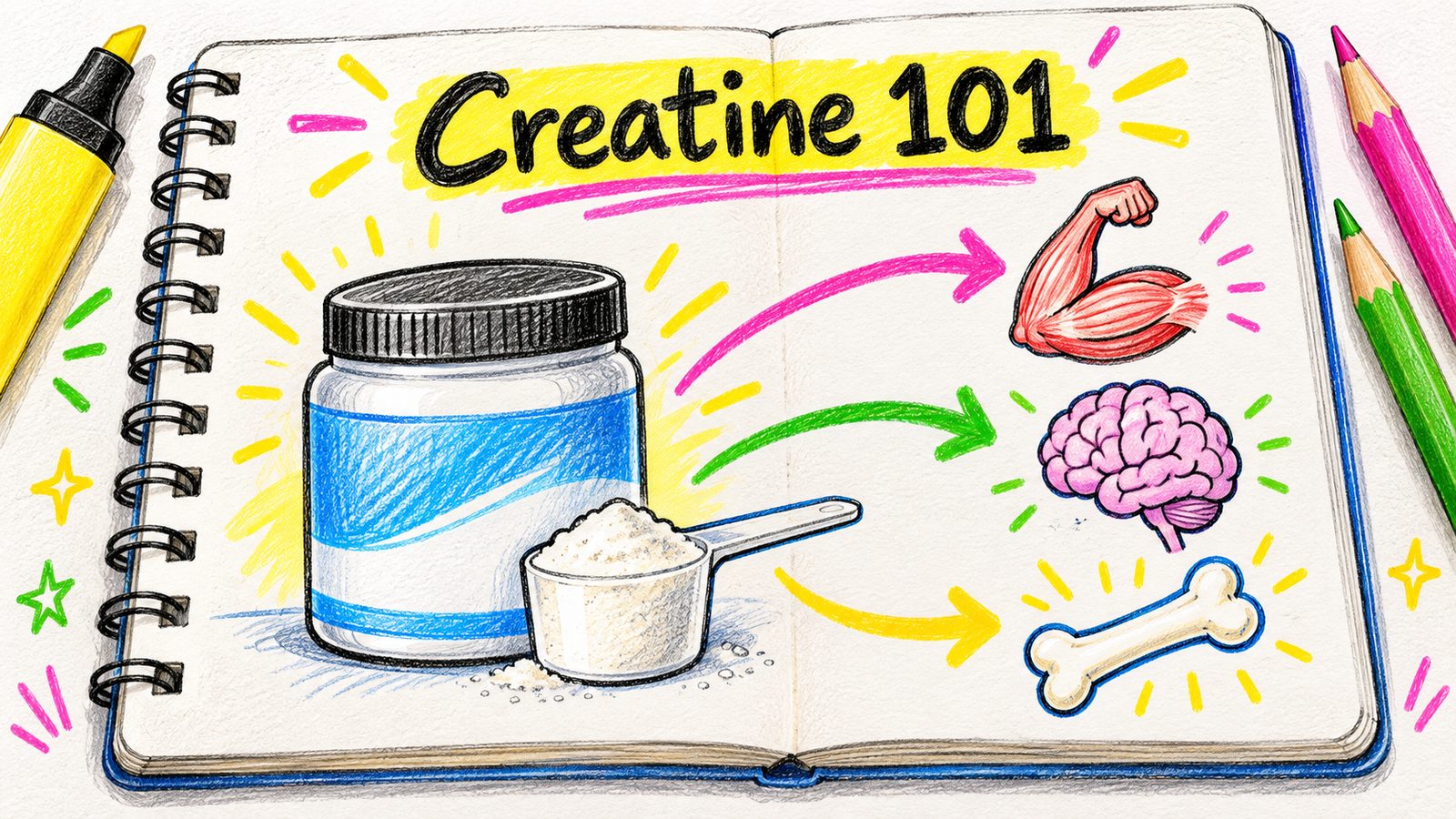
What creatine is, what the research says it does for women, how to start, and the myths to leave behind.
What creatine is, what the research says it does for women, how to start, and the myths to leave behind.
Quick answer: Creatine is a compound your body already makes and stores mostly in muscle, where it helps recycle the energy your cells burn during hard effort. For women just starting out, the research-backed approach is simple: 3 to 5 g of creatine monohydrate per day, taken consistently. It is not a steroid, it does not work overnight, and it does not automatically make you bulky.
Your liver, kidneys, and pancreas build roughly a gram of creatine a day from three amino acids (arginine, glycine, and methionine). If you eat meat or fish, food adds about another gram. About 90 to 95% of the body's creatine sits in skeletal muscle, roughly two-thirds of it as phosphocreatine, the quick-release battery that donates a phosphate to rebuild ATP during short, intense effort.
That is the whole mechanism in one sentence: more phosphocreatine on hand means your muscles can repeat hard efforts with less fade. No hormones, no stimulants, no mystery ingredients. If you eat little or no meat, your starting stores run measurably lower (vegetarians test roughly 20 to 30% below omnivores), which means there is more headroom for supplementation to fill.
Here is the part most beginner guides skip. A 2021 review in Nutrients (Smith-Ryan and colleagues) reported that women carry 70 to 80% lower endogenous creatine stores than men. Women also tend to eat less dietary creatine, since the richest food sources are meat and fish and average intake runs lower.
Lower starting stores mean more headroom to fill. That is one reason researchers describe women as a population that may benefit from supplementation beyond pure sports performance, including strength, body composition, mood, and cognition across the lifespan. It also explains why creatine keeps showing up in women's health research instead of staying in the bodybuilding aisle.
The same review found that creatine supplementation in premenopausal women appears effective for improving strength and exercise performance. In postmenopausal women, higher doses (around 0.3 g per kg of body weight per day) were linked to gains in muscle size and function, and bone benefits appeared when creatine was paired with resistance training. If you are in that stage of life, our guide to creatine for women over 40 goes deeper.
Cognition and mood show early, graded promise rather than proof. Preclinical and clinical work points to positive effects, possibly through restoring brain energy balance, and the reviewers note supplementation may be even more effective for women by supporting what they call a pro-energetic environment in the brain. Treat that as interesting, not settled.
One honest caveat belongs in every beginner guide: most creatine trials enrolled men. The women's evidence base is growing but thinner, which is exactly why this site grades claims instead of hyping them. For the full breakdown of the women's studies, see the research hub.
1. It is not a steroid. Creatine has no hormonal action and is not classified with anabolic steroids anywhere in the sports or medical literature. The International Society of Sports Nutrition's position stand treats it as a nutritional compound with a strong safety record, not a hormone. If someone tells you it works like an anabolic, they are confusing the supplement aisle with the pharmacy.
2. It does not build muscle by itself. Creatine helps you train harder and recover between sets, which lets training produce more adaptation over time. The muscle still comes from progressive training and enough protein. If you do not lift at all, here is what the research says about creatine without exercise before you decide it is pointless.
3. It is not instant. Muscle creatine rises over weeks on 3 to 5 g a day. The classic Hultman study found that 3 g a day raised muscle creatine by about 20% over 28 days, while 20 g a day reached a similar increase in 6 days. Either path ends at the same saturated state, so patience is a valid strategy. Full comparison: creatine loading vs no loading.
4. It will not automatically make you bulky. Women produce far less testosterone than men, and creatine supports the muscle you train for rather than adding size on its own. The scale may move up a pound or two early from water shifting into muscle cells, which is not the same as gaining body fat (explained in creatine water weight in women). The full myth-busting version lives at will creatine make me bulky.
Step 1: buy plain creatine monohydrate. It is the most studied form by a wide margin, and the safety and efficacy conclusions in the literature rest on it. Skip the fancy esters and blends until you have a reason. Gummies versus powder covers the format question if pills and powders are not your thing.
Step 2: take 3 to 5 g once a day. Mix it into water, a shake, or a smoothie. Micronized powder dissolves better if grit bothers you. Take it at whatever time you will actually remember, because consistency beats timing; the timing evidence backs that up. Not sure of your exact number? Run it through the creatine dose calculator.
Step 3: skip the loading phase unless you are impatient. Loading (about 20 g a day split into 4 doses for 5 to 7 days) saturates muscles faster, but the steady 3 to 5 g a day path reaches the same place in about a month with less chance of stomach grumbling. If your stomach is sensitive, how to avoid stomach discomfort has the practical fixes.
Step 4: keep training and eating protein. Creatine amplifies the adaptations your training creates. It does not replace them. For the complete dosing reference, see the creatine dosing guide.
Weeks 1 to 2: probably nothing dramatic. Some women notice slightly fuller-feeling muscles or a pound or two on the scale from water shifting into muscle cells. That is not fat. Missed a day? Here is what to do about missed doses (spoiler: nothing dramatic).
Weeks 3 to 4: training logs start telling the story. An extra rep here, a slightly heavier last set there. The changes are incremental, which is exactly what the research predicts. Saturation is a slow fill, not a switch flip.
For the full week-by-week version with the scale kept in context, read the first-month guide.
Creatine monohydrate is one of the most studied supplements in existence. The International Society of Sports Nutrition position stand reports no evidence that normal intakes (under 25 g a day) cause kidney dysfunction in healthy adults, citing long-term studies running 10 months to 5 years with no detrimental effects on renal function.
Two honest limits. If you have kidney disease, are pregnant or breastfeeding, or take prescription medication, talk to your doctor first. And buy third-party tested products, because supplement quality control is the real variable; the certification guide explains what the seals mean. The full safety breakdown lives at is creatine bad for kidneys. For the decades-long picture, see creatine long-term safety.
Look for three things: creatine monohydrate on the label, a third-party certification mark (NSF Certified for Sport or Informed Sport), and no proprietary blends hiding the dose. Our tested picks live on the best creatine for women page, ranked with per-serving cost math so you can see what 5 g a day actually costs.
Our top pick is Optimum Nutrition Micronized Creatine Monohydrate: the full 5 g studied dose, Informed Choice banned-substance testing, and about $0.23 a day.
Most creatine research enrolled men, so women's-specific dose-response data is thinner than anyone would like. Study averages describe groups, not your personal outcome. Vegetarian and low-meat eaters start from lower stores and may respond differently than heavy meat eaters. This page summarizes published research; it is not medical advice.
Next: Read what the first month actually feels like, with the scale in context.
Editorial note: This page is informational and does not provide personalized medical advice. Study findings describe groups, not guarantees for individuals. If you have a medical condition, take prescription medication, are pregnant, or have symptoms that concern you, discuss supplement use with a qualified clinician.