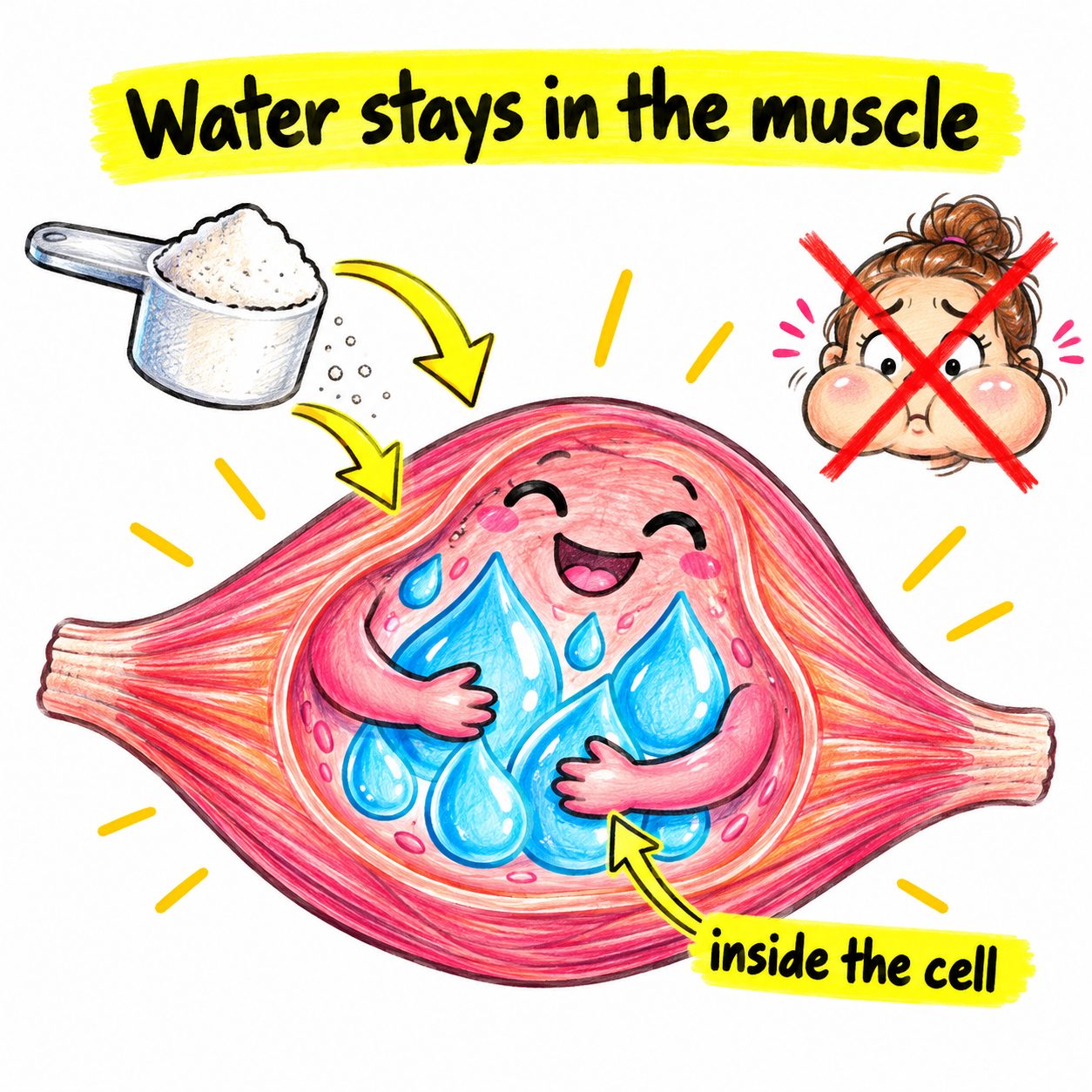
Quick answer: Does creatine cause water retention? An 11-author evidence review published in 2021 gives a two-part answer. In the first few days, yes: water retention is the most commonly reported early side effect, and it is primarily attributed to increased intracellular volume, water held inside muscle cells.
Over longer periods, several studies found no lasting increase in total body water relative to muscle mass. The review authors concluded creatine supplementation may not lead to water retention at all. It does not cause face puffiness or generalized swelling in the trials.
Where the water actually goes: inside the muscle cell
Creatine is osmotically active, which means it can pull water along with it. It is also stored mostly in skeletal muscle. Put those together and the short-term effect makes sense: as muscle creatine rises, water follows it into the muscle cell.
The 2021 review summarized short-term studies showing that three days of creatine increased total body water, extracellular water, and intracellular water. The problem is what happened next: based on those first-days responses, the idea that creatine causes long-term water retention became widely accepted anyway. Longer studies tell a different story, with several showing no meaningful lasting change in total body water relative to muscle mass.
Does creatine cause bloating or a puffy face?
This is really two different fears wearing one costume. Let us separate them.
Puffy face and visible puffiness: no controlled trial has measured facial puffiness from creatine, so honesty requires saying the direct test does not exist. What does exist is water-compartment data, and it points away from the fear. In an 8-week trial of 27 resistance-trained men, the creatine group gained more muscle mass, total body water, and intracellular water than the placebo group, while extracellular water rose similarly in both groups.
The ratio of intracellular water to muscle mass did not change. Translation: the extra water tracked the extra muscle. It did not pool outside the cells the way edema does.
Bloating: the stomach kind is a separate mechanism from water retention. It usually comes from large single doses sitting in the gut, not from water in your muscles. Our stomach discomfort guide covers the practical fixes (smaller doses with food and water tend to help).
Creatine water retention vs water weight vs fat gain
These three get tangled constantly, so here is the clean split:
| What you notice | What the evidence says it is | What to do |
|---|
| Scale up a pound or two in week one | Most likely early water retention, mostly intracellular, especially during a loading phase. | Judge weekly averages under consistent conditions, not single weigh-ins. |
| Face or body looking puffy | No trial reports this as a creatine effect; water-compartment studies show the water goes inside muscle cells, not under the skin. | Look for other causes (salt, sleep, cycle phase) before blaming the scoop. |
| Clothes fitting tighter over months | Water retention does not explain a slow, steady trend; that pattern is usually body fat or muscle change. | Track training, food, and measurements alongside the scale. |
For the full scale-reading playbook written for women, see creatine water weight in women. If size is the worry rather than water, read will creatine make me bulky.
How long does creatine water retention last?
The early water effect is a first-days phenomenon, most visible during a loading phase when muscle creatine rises fastest. The classic loading research found 20 g/day saturated muscle creatine in about 6 days, versus about 28 days at 3 g/day. Faster saturation means faster water movement, and a bigger early scale signal.
Past the early phase, the long-term picture does not support permanent retention. Several longer studies found no consistent lasting increase in total body water relative to muscle mass, which is exactly why the review authors landed on "creatine supplementation may not lead to water retention."
How to keep water weight minimal
- Skip the loading phase. A steady 3 to 5 g/day saturates muscle creatine over about four weeks with a gentler early curve. See creatine loading vs a steady daily dose for the full tradeoff.
- Split large doses. If you do load, dividing the daily amount into 4 smaller doses is the standard approach, and it is easier on the gut too.
- Stay hydrated normally. Creatine is not a diuretic and the dehydration fear is its own myth; drink to thirst and routine, not in fear of the supplement.
- Give it four weeks. Early water noise settles as saturation stabilizes. Judging the supplement on day three is like judging a marathon at the first water station.
When the water question deserves a doctor, not a blog
Creatine's water behavior is benign in healthy people, but visible swelling with shortness of breath, sudden large weight gain, or ankle swelling should never be filed under "probably the creatine." Those patterns need a clinician.
The same goes if you have kidney disease, heart failure, or take medications that affect fluid balance: talk to your doctor before supplementing. See our kidney safety evidence page for what the trials show in healthy adults.
The cell-swelling idea: why researchers think intracellular water helps
Researchers have proposed that the intracellular water creatine pulls into muscle is not just passive baggage. In laboratory models, cell swelling (volumization) appears to signal the cell to grow, sitting upstream of growth pathways like mTOR that drive muscle protein synthesis. That hypothesis, if correct, would mean the early water weight is part of the mechanism, not a side effect of it.
Keep this in the right tier: a plausible mechanism supported by lab models, not a proven clinical chain. What the human trials show is the practical version: the water goes inside the muscle, muscles look slightly fuller, and the performance and lean-mass benefits follow once saturation is reached.
The bottom line for your routine
A little extra water in the first days is normal and expected, and it lives inside your muscle cells. The "creatine makes you retain water forever" version is not what the studies show.
If you want the flattest possible start, skip loading and take 3 to 5 g daily. For the bigger picture on creatine for women, start there.
Next: Read the loading vs no-loading tradeoff, with the water-weight math included.
Sources
- Antonio J, et al. 2021. Common questions and misconceptions about creatine supplementation: what does the scientific evidence really show?
- J Int Soc Sports Nutr 18:13. Used for the short-term intracellular-volume finding, the longer-studies conclusion ("may not lead to water retention"), and the early-days adverse-effect ranking.
- Ribeiro F, et al. 2020. Creatine supplementation does not influence the ratio between intracellular water and skeletal muscle mass in resistance-trained men.
- Int J Sport Nutr Exerc Metab. 27 resistance-trained men, 8 weeks. Used for the intracellular-vs-extracellular water finding.
- Moore SR, et al. 2023. A randomized controlled trial of changes in fluid distribution across menstrual phases with creatine supplementation.
- Nutrients 15:429. 30 moderately active women, 5-day loading. Used for the no-significant-body-mass-change finding.
- Hultman E, et al. 1996. Muscle creatine loading in men.
- Healthy men, n=31. Used for the 20 g/day for 6 days versus 3 g/day for 28 days muscle-creatine time course.
- Cell-volumization hypothesis (mechanistic literature on cell swelling and growth signaling). Used only for the proposition that researchers have proposed intracellular water as part of the growth-signaling mechanism (e.g., upstream of mTOR), stated as a hypothesis from laboratory models rather than a proven clinical chain.
Editorial note: This page is informational and does not provide personalized medical advice. Study findings describe groups, not guarantees for individuals. If you have a medical condition, take prescription medication, are pregnant, or have symptoms that concern you, discuss supplement use with a qualified clinician.