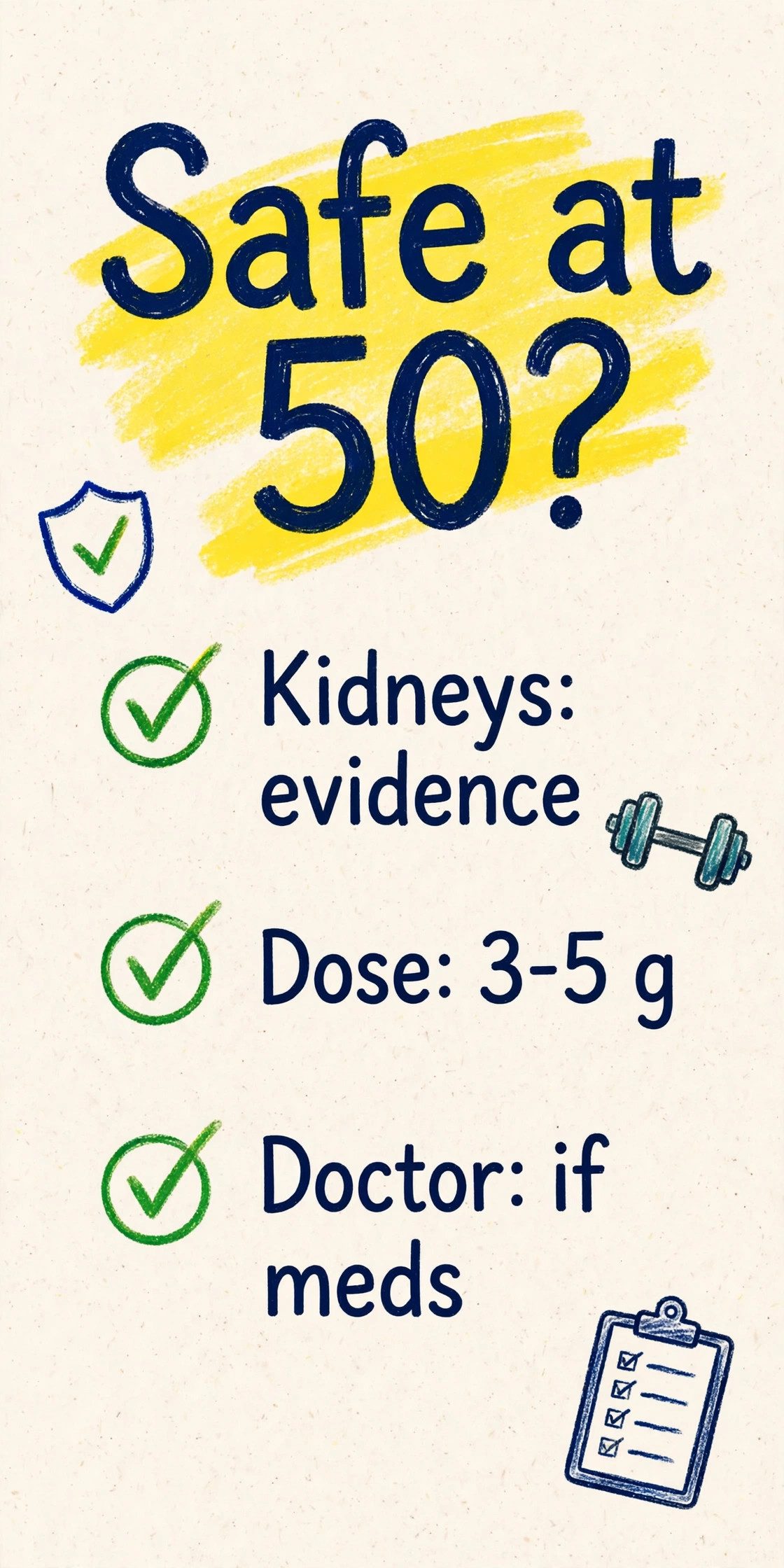
Why 50 changes the safety question (and why the evidence still answers it)
At 50, the safety question gets sharper. Kidneys filter a little slower with age. Prescriptions get more common. Blood pressure enters the chat. A supplement that was a no-brainer at 30 deserves a second look at 50, and you are asking the right question.
The stakes also get higher. After 50, adults lose roughly 1 to 2 percent of muscle mass per year, strength declines even faster, and the average person loses around 30 percent of total muscle between 50 and 80. That loss has a medical name (sarcopenia) and a practical consequence: the muscle you keep is the muscle that keeps you independent. Safety matters precisely because the benefit matters.
So here is the reassurance, graded honestly: the research on creatine in older adults is not thin. It includes year-plus randomized trials in women your age, measured kidney function with gold-standard methods, and the largest safety review the field has produced. For the strength side of the equation, see Creatine for Women Over 50: Sarcopenia, Strength, and What the Trials Found.
The kidney evidence: creatine is not creatinine
The kidney worry almost always traces back to one lab number: creatinine. Doctors use blood creatinine to estimate kidney function (eGFR). Creatine supplements can nudge creatinine slightly upward, which looks alarming until you know the mechanism. Creatinine is a breakdown product of creatine. Taking more creatine means your body makes a bit more creatinine, even when your kidneys are working perfectly.
A 2025 systematic review and meta-analysis of 21 clinical trials settled the distinction. Creatine was associated with a small, statistically significant rise in serum creatinine, but glomerular filtration rate, the actual measure of how well kidneys filter, did not change. The authors' conclusion was unambiguous: the creatinine rise reflects metabolic turnover rather than renal impairment. Creatine can move the number on one kidney test without harming the kidneys behind it.
That finding lines up with trials that measured filtration directly instead of estimating it. In one 12-week study of postmenopausal women, measured GFR (via a precise tracer method) showed no change with creatine. In a 12-month trial of postmenopausal women around age 57, creatinine clearance stayed normal for the creatine group across the entire year. For the full kidney deep dive, read Is Creatine Bad for Kidneys: The 5-Year Studies That Settled It. The one group this does not cover: people with existing kidney disease. That is a doctor conversation, not a blog-post decision.
What the older-adult trials actually ran
The strongest evidence for safety at 50 comes from trials that enrolled people your age on purpose. A 2015 randomized trial gave 47 postmenopausal women (average age 57) either creatine at 0.1 g per kg of body weight per day or a placebo, alongside supervised resistance training three times a week, for 12 months. Creatine clearance stayed normal in the creatine group for the whole year, and bench press strength rose 64 percent versus 34 percent on placebo. The same trial also found creatine slowed bone loss at the femoral neck, the hip site that matters most for fracture risk.
A larger 2023 trial ran even longer: 237 postmenopausal women (average age 59) took 0.14 g/kg/day for two years during resistance training and walking. Creatine improved bone geometry at the hip and increased lean tissue mass in women who completed the program. Fractures were equal in both groups (four each), but the trial was too small to settle the fracture question either way.
Side effects were mild but real. A 2019 review of the older-adult literature noted that in one 52-week trial, five women on creatine reported gastrointestinal irritation and two reported muscle cramping, mildly more than placebo. That is the honest side-effect profile at this dose: occasional stomach grumbling, not organ damage. For the decades-long view, see Creatine Long Term Safety: What 650+ Trials Actually Found.
Dehydration and cramps: the opposite of the rumor
"Creatine dehydrates you" is one of the oldest rumors in the supplement aisle, and the research points the other way. A 2008 review in the British Journal of Sports Medicine concluded there is no reason to believe creatine raises the risk of dehydration or muscle cramps. If anything, the authors argued, creatine may lower the risk by increasing total body water, lowering exercise core temperature, and reducing exercising heart rate and sweat rate.
The field data agrees. A season-long study of collegiate football players found that creatine users had significantly less cramping, less heat illness and dehydration, less muscle tightness, and fewer muscle strains than nonusers training in the same conditions. That is a striking reversal of the gym-floor warning. The practical takeaway at 50 is simple: drink water normally, the way you would anyway. You do not need to overhydrate to "protect" yourself from creatine.
Blood pressure, medications, and the steroid question
Three worries tend to arrive together, so here is each one straight. First, creatine is not a steroid. Your body makes it from amino acids, meat and fish contain it, and the International Society of Sports Nutrition classifies it as a nutritional supplement, not a hormone. The confusion comes from the muscle-building reputation, not the chemistry.
Second, no controlled trial has shown creatine raises blood pressure in healthy adults. That said, "no evidence of harm" is not the same as "proven safe with every prescription." If you take blood pressure medication, diuretics, or anything processed by the kidneys, bring the question to your doctor or pharmacist. That is the correct protocol at 50, when drug interactions are a bigger deal than supplement effects.
Third, diabetes and other chronic conditions. Supervised trials have included adults with type 2 diabetes and other clinical conditions without kidney-function deterioration, but those were supervised trials, not solo experiments. Your clinician knows your full medication list. The internet does not.
The dose the trials used at 50
The older-adult trials did not megadose. They used 0.1 to 0.14 g per kg of body weight per day, which works out to roughly 3 to 5 grams daily for most women. No loading phase. Just a steady daily scoop, the same maintenance dose younger adults use. For the full comparison of the two common doses, see 3g vs 5g Creatine: Which Dose Do Women Need?.
This is worth underlining because the supplement industry loves bigger numbers. The 12-month and 2-year safety data we have is for this dose range, taken daily, usually with training. Staying inside the studied dose is how you stay inside the studied safety. The complete dosing guide walks through the body-weight math if you want your exact number.
Starting from zero at 50? The beginner guide for women walks through week one without the jargon.
Your 50-plus safety checklist
- Pick plain creatine monohydrate. Every safety trial cited on this page used monohydrate, the form with the deepest evidence record. Skip the blends, the buffered versions, and anything with a proprietary formula. If the label has more than one ingredient, it is not the thing the studies tested.
- Take 3 to 5 g daily, steady, no loading. The older-adult trials skipped the loading phase entirely and still saw strength and muscle benefits over months. A steady daily dose is gentler on your stomach, quieter on the scale, and matches the protocol with the safety data. See Creatine Loading vs No Loading for the tradeoffs.
- Book the doctor chat if any of these apply. Existing kidney disease, blood pressure medication, diuretics, diabetes medication, or any condition affecting fluid balance. Bring the bottle or a photo of the label. Ask specifically: "Is there any interaction with my medications?" Five minutes of pharmacist time beats five hours of forum reading.
- Pair it with resistance training. The year-plus trials that proved safety also proved benefit, and the benefit came from creatine plus training, not creatine alone. Two to three sessions a week of challenging resistance work is the protocol the evidence supports. The muscle you keep in your 50s is the independence you keep in your 70s.
- Give it 8 to 12 weeks, then reassess. Muscle creatine saturates over weeks, not days, on a steady dose. Judge by training performance and how daily life feels, not by week-two scale noise. If anything feels off at any point, stop and check with your clinician. Supplements are optional. Your peace of mind is not.
The honest limits of this page
Study averages are not personal predictions, and the older-adult trials mostly paired creatine with supervised resistance training, so the safety record describes that combination. Advanced kidney disease remains under-studied, which is exactly why the doctor conversation is non-negotiable for that group. Very high doses at 50-plus are also not well studied, and this page does not test them, so it does not endorse them.
What the evidence does support is specific: standard doses of creatine monohydrate, taken daily, in otherwise healthy adults at 50 and beyond, look safe across year-plus trials, direct kidney-filtration measurements, and the field's largest safety review. That is a strong sentence, and it is the sentence the data earns.
Next: Read the 50-plus strength guide, with the trial results that matter at your age.
Once the safety question is settled, which creatine to buy at 50 is a separate page.
Sources
- Kreider RB, et al. 2017. International Society of Sports Nutrition position stand: safety and efficacy of creatine supplementation in exercise, sport, and medicine. Used for the no-compelling-evidence-of-harm conclusion in healthy individuals (up to 30 g/day for 5 years) and the infants-to-elderly safety framing.
- Kabiri Naeini et al. 2025. Effect of creatine supplementation on kidney function: a systematic review and meta-analysis. 21 clinical trials. Used for the small serum creatinine rise with no change in GFR, and the metabolic-turnover-not-impairment conclusion.
- Chilibeck PD, Candow DG, et al. 2015. Effects of creatine and resistance training on bone health in postmenopausal women. 12 months, 0.1 g/kg/day, mean age 57. Used for normal creatinine clearance throughout, the 64% vs 34% strength result, and the femoral-neck bone finding.
- Chilibeck PD, et al. 2023. Effects of creatine supplementation on bone health in postmenopausal women: a 2-year randomized controlled trial (Med Sci Sports Exerc 2023;55(10):1750-1760). 237 women, 0.14 g/kg/day for 2 years with resistance training and walking. Used for the hip bone geometry and lean tissue mass findings, and the equal fracture counts.
- Greenwood M, et al. 2003. Cramping and injury incidence in collegiate football players are reduced by creatine supplementation (J Athl Train 2003;38(3):216-219). One season, 38 creatine users vs 34 nonusers. Used for the significantly lower cramping, heat illness/dehydration, muscle tightness, muscle strains, and total injuries among creatine users.
- Dalbo VJ, et al. 2008. Putting to rest the myth of creatine supplementation leading to muscle cramps and dehydration. Used for the no-increased-dehydration-or-cramp-risk conclusion and the possible hyperhydration benefit.
- Candow DG, et al. 2019. Variables influencing the effectiveness of creatine supplementation as a therapeutic intervention for sarcopenia. Used for older-adult adverse-event reporting (GI irritation, cramping in a 52-week trial) and the sarcopenia treatment framing.
Editorial note: This page is informational and does not provide personalized medical advice. Study findings describe groups, not guarantees for individuals. If you have a medical condition, take prescription medication, are pregnant, or have symptoms that concern you, discuss supplement use with a qualified clinician.