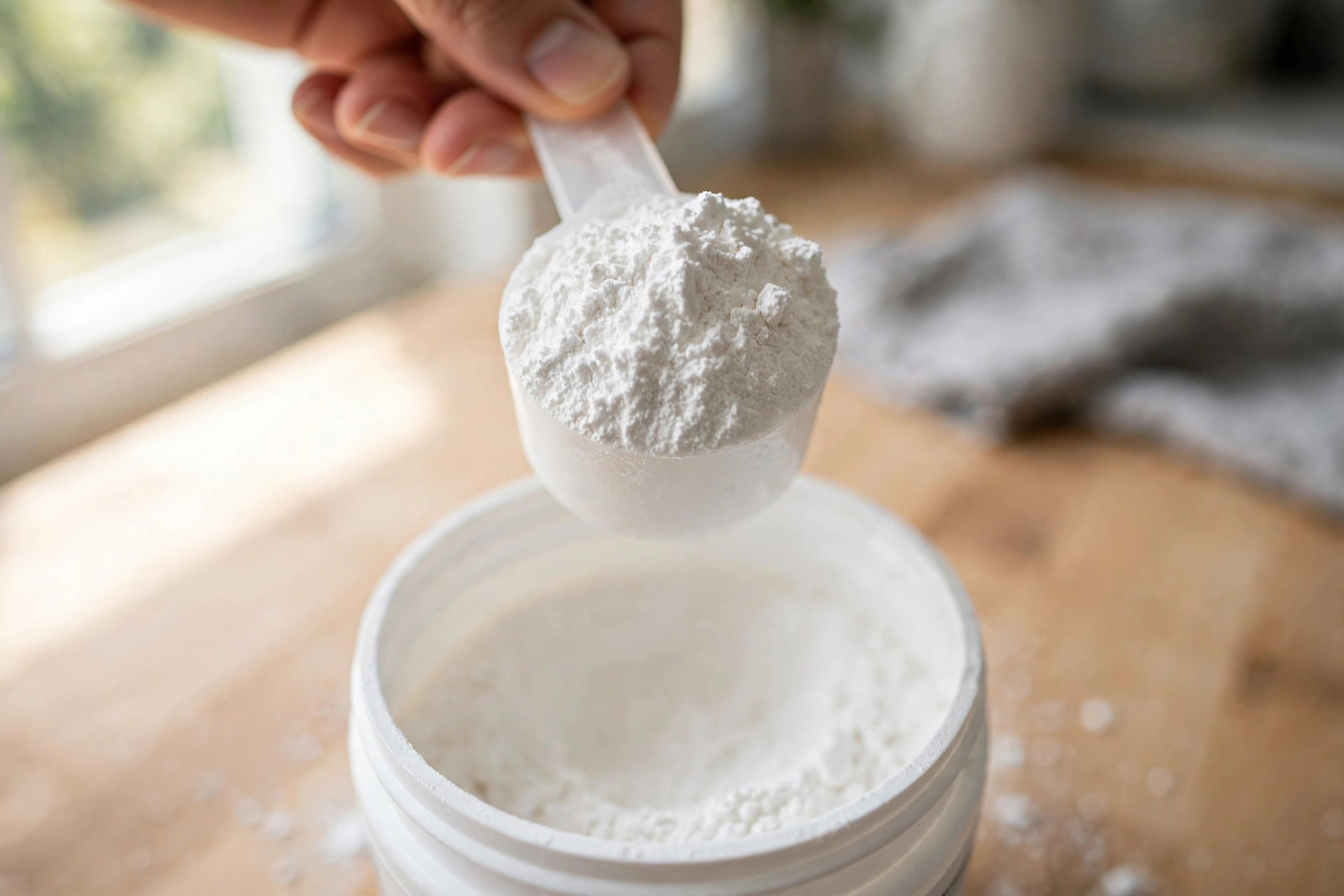
Somewhere along the way, supplement companies decided women over 40 need a special creatine. They do not. They need the same 5 grams of monohydrate the research studied, from a maker whose label tells the truth. Here are the five tubs that clear that bar, ranked by what actually matters at midlife.
Quick answer: Optimum Nutrition Micronized Creatine is our #1 pick: 5 g per serving, Informed Choice tested, about $0.23 per serving, twenty years of track record. Thorne is the best certified option at about $0.49 per serving. BulkSupplements is the honest budget pick at about $0.17 per serving. Every pick below is single-ingredient, unflavored, and dosed at the studied 5 g. None of them is pink.
After 40, you take creatine for different reasons than a 25-year-old: holding onto muscle, supporting bone density alongside resistance training, steady energy. The product does not change, only the priorities. You want one unflavored powder, an honest 5-gram dose, a third-party seal, and a price that does not insult you. The #1 pick below checks all four at about $7 a month. Everything else on this list is for specific situations, which we will name.
Let us get this out of the way. At 5 grams a day, creatine does not make you look bloated. The water it pulls goes into your muscles, which is the entire point, not under your skin. The puffy-face stories come from loading phases at 20 grams a day, which you do not need to do. Five grams daily, no loading, no bloat. Our midlife guide has the full evidence breakdown if you want it.
Walk the supplement aisle and you will find tubs in pastel colors promising "toning blends" and "lean formulas." Flip them over. The good ones contain 5 grams of creatine monohydrate, exactly like the plain tub, plus a smaller dose of something cheap and a bigger price tag. The bad ones hide the dose inside a proprietary blend, so you cannot even verify you are getting 5 grams. Either way you pay more for less information. The five picks below all print their exact dose on the label. That is the whole filter.
Five grams per serving. One hundred twenty servings per tub. Informed Choice certified, which means an independent lab tests it for banned substances. About $0.23 a serving, around $28 for the tub, roughly $7 a month. Micronized so it actually dissolves instead of turning your smoothie gritty. Unflavored, so it disappears into whatever you already drink in the morning.
The trade-offs, stated plainly: no scoop in the tub, so you measure a rounded teaspoon or weigh 5 grams on a kitchen scale. And no NSF Certified for Sport seal, which only matters if you compete in drug-tested sport. For everyone else, this is the best blend of price, testing, and twenty years of track record we found.
Five grams per serving, 90 servings, NSF Certified for Sport, about $0.49 a serving (around $44). This is the strictest independent testing in the industry: every batch screened, label verified. Thorne is also the brand sports dietitians recommend most often, and it leans into cognitive function in its positioning, which matches how many women over 40 actually use creatine.
The honest math: roughly double the #1 pick per serving, paying for a seal most non-athletes do not strictly need. Buy it for maximum assurance, not for better results. The creatine is the same molecule.
Five grams per serving, 100 servings in a 500-gram pouch, about $0.17 a serving (around $17). The cheapest honest price we verified anywhere. The company publishes third-party certificates of analysis for its products and manufactures in an NSF-certified cGMP facility. Now the precision that matters: the facility is certified, which is not the same as an NSF Certified for Sport product seal. Nobody is testing every batch for banned substances here.
What you give up: the tub (it is a pouch, fine for the pantry, less pretty on the counter), the branding, and the seal. What you keep: the most creatine per dollar on this list, full stop.
Five grams per serving, NSF Certified for Sport, German Creapure sourcing, packaging that looks like it belongs in a design museum. The 90-serving size at about $0.44 a serving (around $39.95) is fairly priced for this tier. The 30-serving jar at about $0.83 a serving is not; skip it without a second thought. Buy this if sourcing provenance matters to you and you will commit to the large size. Our Momentous vs Thorne breakdown has the full premium-tier comparison.
Five grams of micronized monohydrate per serving, 80 servings per tub, about $0.24 a serving (around $19.58). Scoop included, which the #1 pick does not have, and the label prints a loading protocol. The watch-out: the "HPLC-tested and third-party verified" claim is the manufacturer's own testing program, not an independent seal. If certification is not your priority, this is a perfectly fine tub at a fair price. If it is, look higher on this list.
At 5 grams a day, fairly priced creatine costs $5 to $8 a month. The #1 pick lands around $7. The budget pick lands near $5. If you are paying much more than $15 a month, you are paying for branding or a certification seal, not for better creatine. Run any tub through the cost and supply calculator before you buy, because the sticker price is the most misleading number on the shelf.
Five verifiable criteria, same as every product we assess: dose accuracy, third-party certification, price per serving (computed from Amazon listings last checked October 6, 2026; prices move, so verify), label transparency, and manufacturer track record. No lab coats were worn; we do not claim personal laboratory testing. Research-based assessment; not independently lab tested. Full methodology in the disclosure.
This roundup summarizes label facts and published research for information purposes. Talk to your doctor before starting any supplement, especially if you take medication or manage a health condition.
Our #1 pick for 40+: Optimum Nutrition Micronized Creatine, about $0.23 per serving.
Check price on Amazon