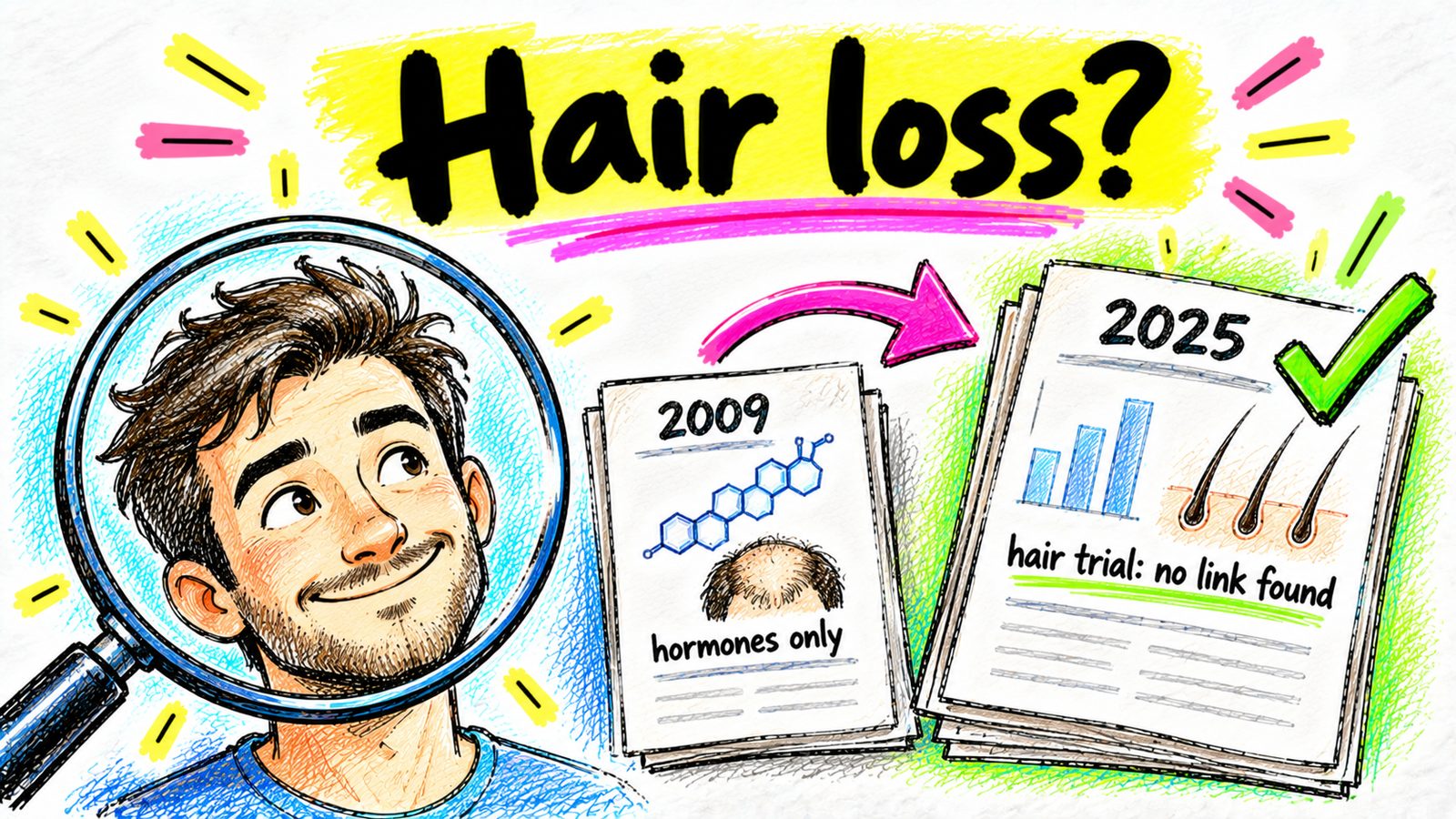
Quick answer: The best evidence says no. The claim comes from one 2009 study of 20 college-aged male rugby players, where the hormone DHT rose during three weeks of creatine use.
Hair was never measured. In 2025, a randomized trial finally measured hair directly: 38 resistance-trained men took 5 g of creatine or a placebo daily for 12 weeks while researchers tracked hair density, follicle counts, hair thickness, DHT, and testosterone.
No differences between the groups on any measure. For women, no trial has measured hair outcomes yet.
The study: what van der Merwe 2009 actually measured
The paper is van der Merwe, Brooks, and Myburgh, published in the Clinical Journal of Sport Medicine in 2009: "Three Weeks of Creatine Monohydrate Supplementation Affects Dihydrotestosterone to Testosterone Ratio in College-Aged Rugby Players." Small study, specific question, and worth reading precisely.
Twenty college-aged rugby players took part in a double-blind, placebo-controlled crossover trial with a six-week washout. The creatine group loaded with 25 g/day for 7 days, then took 5 g/day for 14 days of maintenance. Researchers measured serum testosterone and DHT at baseline, day 7, and day 21, plus body composition.
The results: serum testosterone did not change. DHT rose 56% after the loading week and stayed about 40% above baseline through maintenance.
The DHT-to-testosterone ratio rose 36% after loading and stayed about 22% elevated. Those are real, statistically significant numbers from the published abstract.
Now the critical part: hair was never measured. The outcomes were hormones and body composition. Nobody counted hairs, photographed hairlines, or asked about shedding.
Hair loss appears nowhere in the study's methods or results. It entered the story later, added by other people.
Why the internet ran with it
DHT (dihydrotestosterone) is a name hair-loss forums already knew. It is the androgen most directly implicated in male-pattern hair loss: in genetically susceptible people, DHT miniaturizes scalp follicles over time. So when a study showed creatine nudging DHT upward, forums connected two dots and drew a straight line between them: creatine raises DHT, DHT causes baldness, therefore creatine causes baldness.
Each step of that chain has a problem. Blood DHT is not scalp DHT, and follicles respond to local tissue levels, not whatever a blood draw shows.
Higher DHT does not cause hair loss in people without the genetic susceptibility; plenty of men with high DHT keep full heads of hair. And the study itself ran three weeks in 20 young male athletes, a design that cannot speak to long-term hair outcomes in anyone, let alone women.
The claim also got laundered through repetition. "Studies show creatine causes hair loss" sounds authoritative until you ask which studies, plural. There is one, and it did not study hair loss.
2025: the trial that finally measured hair
Sixteen years after the rugby study, researchers ran the experiment everyone had been waiting for. Lak, Forbes, Antonio, Tinsley, and colleagues published "Does creatine cause hair loss? A twelve week randomized controlled trial" in the Journal of the International Society of Sports Nutrition in 2025, and the title tells you exactly what they did.
Forty-five resistance-trained men aged 18 to 40 enrolled; 38 completed the study. Half took 5 g of creatine monohydrate daily, half took a maltodextrin placebo, for 12 weeks.
Instead of relying on blood hormones as a stand-in, the researchers looked at the scalp directly, using phototrichogram imaging assessed by certified dermatologists. They measured hair density, follicular unit counts, and cumulative hair thickness, alongside serum DHT and total and free testosterone.
The result was unambiguous: no significant differences between the creatine and placebo groups on any measure. Not hair density, not follicle counts, not hair thickness, not DHT, not the DHT-to-testosterone ratio. Even the hormonal basis of the original scare did not reproduce at a steady 5 g daily dose.
Honest grading means naming the limitations too. DHT was measured in blood, not in scalp tissue. The participants were not pre-selected for hereditary hair-loss risk.
And 12 weeks is short against the years-long course of male-pattern hair loss. No evidence of harm in 12 weeks is not a lifetime guarantee for men at high genetic risk. But it is the first direct measurement ever taken, and it points firmly against the myth.
Where that leaves the 2009 finding
The rugby study's DHT bump was never replicated in 16 years, and the one trial that finally tested the actual claim found nothing. Reviewers had already noticed the weakness: a 2021 evidence review on creatine misconceptions concluded that the majority of evidence does not support a link between creatine supplementation and hair loss or baldness. The 2025 trial turned that skeptical conclusion into a measured one.
It is still worth being precise about what "no evidence" means. The 2025 trial is one study, in young men, over 12 weeks. It does not cover women, and it does not cover decades.
But the claim's entire foundation was one small, short, unreplicated hormone finding, and the first trial to measure hair directly found no effect. If creatine routinely thinned hair, this is the trial that would have caught it.
What would make the answer airtight
The 2025 trial answered the core question for young men over 12 weeks. A truly airtight answer would extend it: women included, participants pre-selected for hereditary hair-loss risk, scalp-tissue DHT measured alongside blood, and follow-up over a year or more. That trial does not exist yet.
Until it does, the rational position is proportionate to the evidence: a single unreplicated hormone finding in 20 rugby players, weighed against a direct 12-week hair trial that found nothing, is not a reason to fear for your hair. The research hub tracks the key papers if you want to read the primary sources yourself.
The bottom line, especially for women
For women, the claim is thinner than it sounds: every direct measurement so far involved only men, and women's shedding has well-known, common causes that deserve attention first: stress, illness, crash dieting, iron deficiency, thyroid shifts, and postpartum changes, among others. Hair shedding also lags its trigger by two to three months, so shedding that starts the week you begin creatine was almost certainly set in motion before the first scoop.
If shedding persists or worries you, see a clinician or dermatologist rather than troubleshooting from the supplement shelf. And if you want the full women's picture, Creatine for Women covers what the evidence actually supports. For the dosing side, including why loading is optional, see Creatine Loading vs No Loading and the dosing guide. For the decades-long safety record across all outcomes, see creatine long-term safety.
Limitations
This page grades the existing evidence; it cannot prove a negative with absolute certainty. The van der Merwe study is small, short, male-only, and unreplicated, which limits both the scare and any firm dismissal. The 2025 trial is the first direct measurement, but it ran 12 weeks, in young men not selected for hair-loss risk, and measured DHT in blood rather than scalp tissue.
Individual reports of shedding while taking creatine exist online, but anecdotes cannot separate coincidence from cause, especially with a symptom as common and delayed as hair shedding. Anyone with persistent or patterned hair loss should get a clinical evaluation.
Next: Read the studies themselves, summarized in plain English, in the research hub.
Sources
- van der Merwe J, Brooks NE, Myburgh KH. 2009. Three weeks of creatine monohydrate supplementation affects dihydrotestosterone to testosterone ratio in college-aged rugby players.
- Clinical Journal of Sport Medicine, 19(5), 399-404. Used for the study design (n=20, double-blind placebo-controlled crossover, 25 g/day for 7 days then 5 g/day for 14 days), the DHT findings (+56% after loading, +40% above baseline in maintenance; DHT:T ratio +36% then +22%), unchanged testosterone, and the fact that hair loss was not among the measured outcomes.
- Antonio J, et al. 2021.
- Common questions and misconceptions about creatine supplementation. Used for the conclusion that the majority of evidence does not support a link between creatine supplementation and hair loss or baldness.
- Lak M, Forbes SC, Ashtary Larky D, Dadkhahfar S, Robati R, Nezakati F, Khajevandi M, Naseri S, Gerafiani A, Haghighat N, Antonio J, Tinsley G. 2025. Does creatine cause hair loss? A twelve week randomized controlled trial.
- Journal of the International Society of Sports Nutrition. Used for the 2025 direct trial: 45 resistance-trained men aged 18-40 enrolled, 38 completed; 5 g/day creatine monohydrate vs maltodextrin placebo for 12 weeks; phototrichogram hair density, follicular unit counts, cumulative hair thickness assessed by certified dermatologists; serum DHT, total and free testosterone; no significant differences between groups on any measure. See the Examine.com evidence summary for an accessible breakdown.
Editorial note: This page is informational and does not provide personalized medical advice. Study findings describe groups, not guarantees for individuals. If you have a medical condition, take prescription medication, are pregnant, or have symptoms that concern you, discuss supplement use with a qualified clinician.